
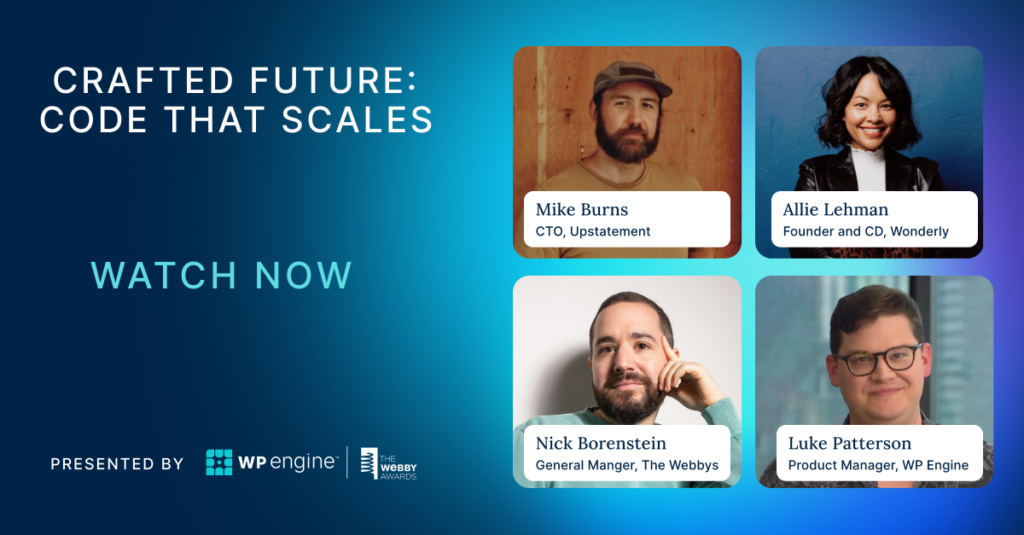
Crafted Future: Redefining Code with Intention
The web is saturated with AI-generated content and code. While the barrier to building has never been lower, the challenge of creating something meaningful has never been higher.
Builders have to stop thinking about how AI can allow them to make more—more sites, more pages, more content—and start thinking about using their human judgment to help their clients say and do more. With modern tools comes a responsibility to prioritize depth over demand and human connection over raw traffic volume.
Intentional innovation was the main topic at our most recent Crafted Future webinar. Crafted Future: Code Redefined explores how teams are using intelligent systems not as something to be tacked on, but as a way to reclaim time for creativity and build platforms that last.
What Is Crafted Future?
Crafted with Code, now in its seventh year, is an annual showcase created by The Webby Awards and WP Engine that celebrates outstanding Webby-recognized projects built on WordPress®[1].
The Crafted Future virtual event series provides a way to dive deeper into those stories, offering a behind-the-scenes look at what it takes to build Webby-worthy work. The series brings together technical experts and creative leaders to share practical lessons on building solutions that solve problems, cultivate community, and stand out visually.
Meet the panel
Moderated by Nick Borenstein, General Manager of The Webby Awards, the panel features:
- Allie Lehman: Owner and creative director at Wonderly, a digital firm focused on helping personality-driven brands build fully owned platforms to connect with their audiences.
- Mike Burns: Chief Technology Officer at Upstatement, an agency that focuses on building story-driven brands digitally with an editorial mindset.
- Luke Patterson: Product manager for WP Engine’s AI-focused products and infrastructure.
Together, the panelists discussed the transition from experimental AI to a more settled phase in which the importance of human judgment and user experience outweighs the individual tools in a build.
Intentional tools: More AI can’t automate better work
The conversation opened with a statement most builders are quickly coming to understand: The smartest digital experiences aren’t necessarily the ones using the most AI. They are the ones using it with the most purpose.
Luke noted that as AI is dropping the price of building, true value comes from the human judgment used to decide what to build and why.
“You can now build almost anything,” says Luke Patterson. “The cost of building what you want is going way down. So intentionality about which problems to solve, who you’re solving them for, and whether they’re properly scoped becomes much more important.”
Once you understand your user’s needs, development teams must take accountability for building experiences that strengthen the trust a brand has already earned with its audience.
Predictable tools still provide the best foundation for innovation
The panel highlighted two Webby-recognized projects that exemplify this intentionality.
- The Food Section, created by Allie’s team at Wonderly, was nominated for a Webby Award in the Independent Publishers category.
- Mozilla Builders, created by Mike’s team using WordPress and WP Engine’s managed platform, was nominated in the Corporate Social Responsibility category.
Both of these nominated sites use WordPress. While established technologies may not have the same buzz as the latest tools, choosing WordPress as a foundational element in these projects allows brands to focus on what’s most important: connecting with their audiences.
Mozilla Builders: Making the case for “boring” technology
Mike shared the journey of building Mozilla Builders with a strict six-week deadline.
Despite building for a program at the cutting-edge of the AI movement, Upstatement chose to use what they affectionately call a “boring” stack. Choosing predictable, ubiquitous technology like WordPress and WP Engine allows editors on the Mozilla Builders site to focus on publishing high-quality content that empowers the community. For his team, AI by itself isn’t always the answer, but it can be an accelerator.
“I look for places where the promise of AI maximizes time spent on the human factors of a project,” he says. “There’s a risk of false productivity. Generating a lot of code can feel like doing a good job, but the real question is: Is that code actually solving the problem?”
The Food Section: Culinary content designed for consumption
What started as a successful Substack newsletter soon reached the limiting edges of a platform not designed to grow alongside its audience. Wonderly worked with Hanna Raskin, founder of The Food Section, to address those limitations by building an experience she can truly own.
Moving to an independent stack built on WordPress, Memberful, and Campaign Monitor allowed the publication to design for the depth of interaction Raskin imagined for her audience.
One standout feature is the Potluck. The tool sits at the top of the home page with a button that says “Take me to a random article.” When clicked, it surfaces random archive stories so The Food Section can get more mileage out of its content. The new, standalone site allows users to choose their own adventure and consume content outside of a traditional “feed” format.
Designing for real audiences in the age of bot traffic
As AI changes how content is discovered and summarized, the panel addressed the growing problem facing creators: how to maintain audience connection when bot traffic is inflating, and human traffic is dropping and being intercepted by AI summaries.
Luke emphasized that while dashboards can track bots, the goal is to find the “aha moment” for a human user.
“Dashboards point to something, and that something is always a person. So ultimately, you need to go talk to them. Did this do the thing you wanted? Did it do the thing you expected? At the end of the day, we build technology for people, not technology for technology,” he says.
Allie brought up a compelling argument for attracting and keeping a human audience. She believes the future of digital platforms lies in community. Creating spaces where members can meet and interact with each other, not just the platform owner or host, provides extra incentive for users to buy into a brand.
“A membership is more powerful when people can meet each other. If someone connects with another member within the first few days, they’re much less likely to leave because their interactions are growing and they’re not solely dependent on the host.”
When anyone can build, good judgment is the differentiator
Because vibe coding practices and AI tools can spin up prototypes in minutes, panelists agreed that human taste is more valuable than ever.
Mike noted that knowing the fundamentals of good design and development is what leads to cohesion. Without that knowledge, any client can ask any developer to simply include as many bells and whistles as possible without focusing the design on what users actually want and need.
“When you can build every feature quickly, it’s very easy to throw everything at the wall,” he says. “The experience building software and understanding how it’s used and how it’s supported requires not just the same discipline, but more discipline.”
Allie went a step further, sharing that imperfections are often what make a brand feel human. Knowing when to break the rules and bringing your clients along on the design journey is something AI simply cannot replicate.
“Taste is everything. My design team is all artists. We’re craft enthusiasts, and the branding we produce is imperfect in a way only a human can achieve. Those imperfections are really difficult for AI to replicate, because it takes a human to know how to properly break rules. AI can break rules, but it looks off,” she says.
“I also think the experience of working through feedback and watching something evolve takes time. AI can give you a lot of visual starting points, but it takes time to fall in love with something and feel like it’s really yours.”
As the barrier to entry drops, Luke made the case for brands to prioritize infrastructure that allows them to scale without losing control. He likens the development experience to building a sandwich.
You can certainly make a sandwich from scratch, milling your own flour to bake your own bread, growing your own vegetables, and raising your own livestock. But at the end of the day, we often choose certain “store-bought” options to save time and headaches without compromising the integrity of the final “meal.”
The same is true for technology. While it may sometimes behoove a team to build an experience entirely from scratch, partnering with different providers for infrastructure may be the difference between getting a good meal on the table and working twice as hard for something less satisfying.
“Unless you’re a software company, draw the line of what you’ll own very intentionally, and let the rest be someone else’s problem,” he says.
Pair innovation and good instincts with WP Engine
Despite the rapid changes of the last few years, the panel ended optimistically. AI has made it easier than ever to take notes in discovery meetings, prototype new experiences and features, and help clients truly own their revenue streams and audience relationships.
Teams are no longer focused on simply what AI can do. They’re thinking about how AI can accelerate the production of truly meaningful, intentional experiences.
Thank you to our partners at The Webby Awards and our panelists for sharing their insights into the future of the web! Get a deeper look at some of the Crafted with Code projects built on WP Engine, or check out the full Crafted with Code YouTube playlist.
Start the conversation.